 Story Atom
 Lucid Lines
 Roll Ignition
SpatialLang
Less output. More world.
SpatialLang turns plain words into an editable 3D world at real scale — ready for actors to perform in and cameras to move through.

01 · Less output. More world.
30 tokens. 40 objects.
Two lines the AI writes. The engine transposes them into 40 exact, typed objects - every size, position and rotation. Written out in prose, the same district takes 3,871 tokens.
W seed=4471 u=m tod=day
R city(dn=6,hs=14,pz=0,sy=5)
gate4.settlement.40 \u00b7 certified \u00b7 grok-4.3 tokenizer
Create the following exact deterministic SpatialLang scene in meters.
Use world seed 4471, time of day day, and preserve every identifier and transform listed below.
The scene contains exactly 40 semantic objects; do not add, remove, rename, or relocate any object.
Entity city.hs1 is catalog object prefab.building.house with code hs, role module, geometry box, size (10, 5, 8), center (4.36981426911, 2.5, -1.10666858959), rotation (0, 0, 0), scale (1, 1, 1), color #8aa2ad, opacity 1, and wireframe false.
Entity city.hs10 is catalog object prefab.building.house with code hs, role module, geometry box, size (10, 5, 8), center (-65.5083169233, 2.5, 21.5513023955), rotation (0, 0, 0), scale (1, 1, 1), color #8aa2ad, opacity 1, and wireframe false.
Entity city.hs11 is catalog object prefab.building.house with code hs, role module, geometry box, size (10, 5, 8), center (12.195460779, 2.5, -53.3037807858), rotation (0, 0, 0), scale (1, 1, 1), color #8aa2ad, opacity 1, and wireframe false.
\u2026 34 more entity lines
02 · The technology
A language, not a picture.
SpatialLang is a strict, line-by-line world language. Every object code is a single token for the model. A validator checks every placement before anything is written, and procedural rules expand the short source into the full scene - deterministically.
Brief
Plain language
AI + grammar
Cached grammar, registry, examples
SpatialLang
171 one-token codes
Validate
Parser · registry · physics of space
Expand
Deterministic procedural rules
Scene IR
Same input, same world - every time
171 of 171 codes measured as a single token on the model's own tokenizer.
Nothing is written until it passes. Illustrative messages; the loop is real.
03 · Describe it
Type a sentence. Get a place.
Riverside Village, built live from an empty 40 × 40 m board. Each request reads the world so far: the stalls face the well, the lamps flank the road. Real request, real generation time.
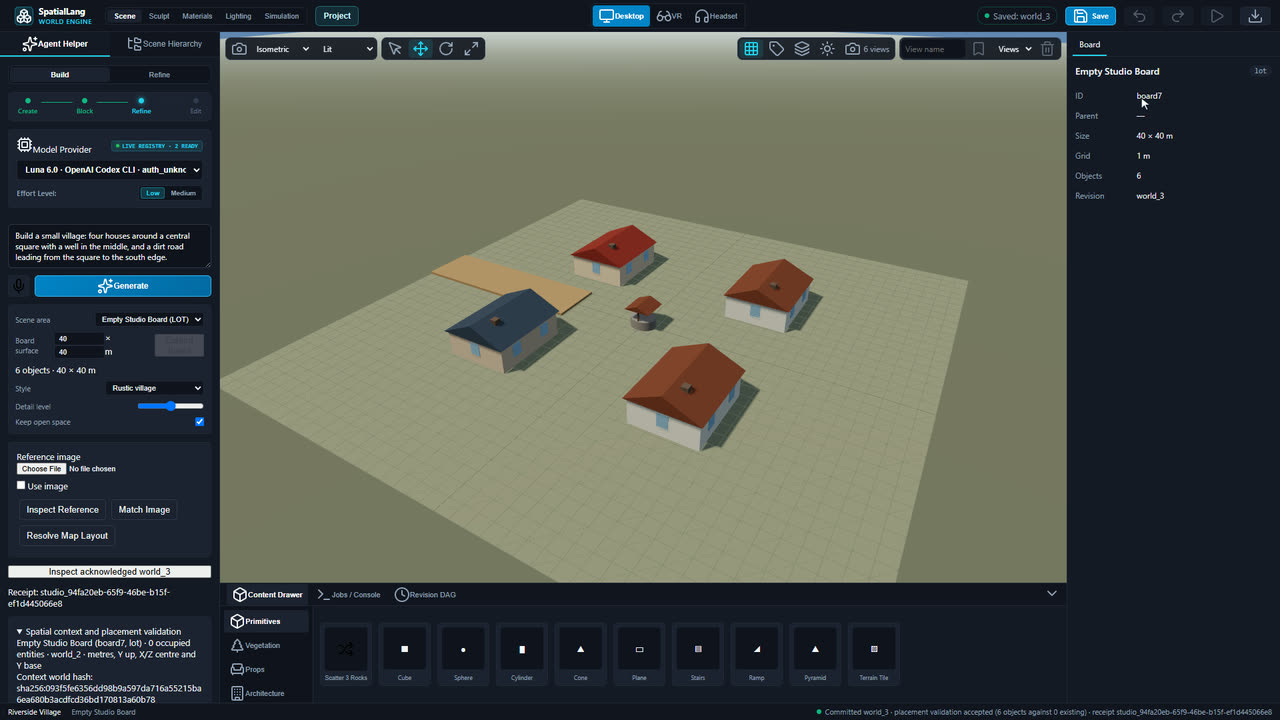 Real Studio output
Build a small village: four houses around a central square with a well in the middle, and a dirt road leading to the south edge.
Add a small market: three stalls in a row on the east side of the square, facing the well.
Plant a row of pine trees along the north edge, and a few oak trees between the houses.
In the south-west corner, add a pond with a small wooden dock and a bench facing the water.
Line the road with lamp posts on both sides, about every 5 metres.
04 · On the clock
Nothing sped up in secret.
Uncut screen recordings with the real wall-clock time burned in. We play them at 4× - the counter keeps true seconds, including the wait for the model and every self-repair.
05 · Any world
Four worlds. 19 of 19 requests.
A village, a castle, a forest camp and a harbour - each from an empty board, built only by typing. Every request committed; seven were fixed by the engine's own self-repair on the way.
Riverside Village
6 requests · 63 s of generation
Ravenhold Keep
5 requests · 67 s · 3 self-repairs
Pinewood Camp
4 requests · 78 s · 4 self-repairs
Saltmarsh Harbour
4 requests · 28 s of generation
06 · Trust it
Big asks. Full history.
"Plant a forest of 300 trees" becomes a representative forest in the free space - not a failure. And every change is a saved revision you can undo, redo or branch from, kept in a local project file.
07 · Direct it
Then put people in it.
A plain-language direction becomes a cast, timed moves and named cameras on a finished world. The scene never changes the world - it's a saved, replayable timeline.
▍
4
cast
19
moves
42 s
scene
9 s
to direct
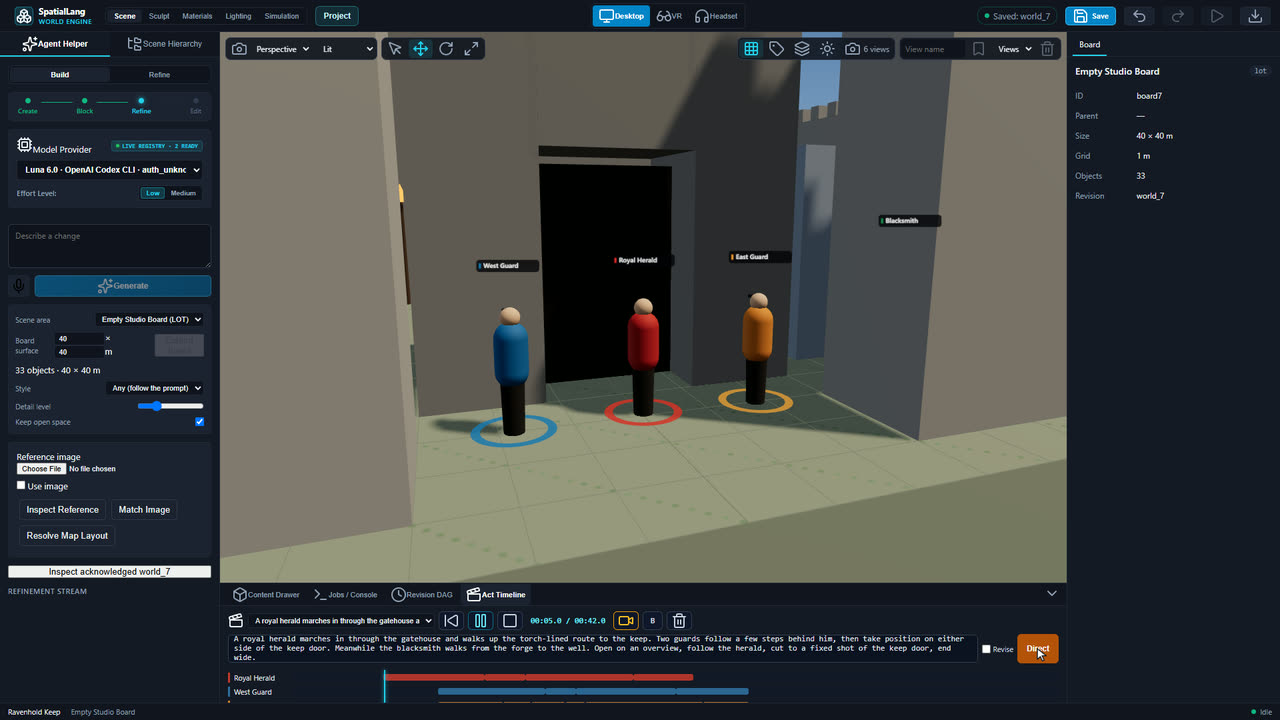 Beat 1 of 4 · real playback
08 · Shoot it
Cast in the world. Any camera.
Directed performers moving through real SpatialLang worlds, shot from named and free cameras. Every frame here is a native Studio render - stand-in figures, real timing.
One 22 s performance - the mayor, Mara and Tomas walking the village road - exported from eight named cameras at once, frame-synchronised.
09 · Finish it
Blockout in. Cinema out.
Drag across the frame. Underneath is the moving SpatialLang blockout; on top is the AI video it drove. Same shot, same layout - the world gives the model a concrete reference.
10 · Honestly
What works today. What's next.
Geometry is stand-in art sized from the generated dimensions, and performers slide rather than walk. The language, the engine and the evidence are real.
- ●Plain language → editable 3D world
- ●Validation + automatic self-repair
- ●Durable revisions, undo / redo
- ●Directed cast, moves and named cameras
- ●Certified 129× token compression
- ○Final art swap for stand-in geometry
- ○Walk cycles for performers
- ○Reusable, connected spaces
- ○Editing inside VR on the stage
01 · Less output. More world.
30 tokens. 40 objects.
Two lines the AI writes. The engine transposes them into 40 exact, typed objects - every size, position and rotation. Written out in prose, the same district takes 3,871 tokens.
W seed=4471 u=m tod=day
R city(dn=6,hs=14,pz=0,sy=5)
gate4.settlement.40 \u00b7 certified \u00b7 grok-4.3 tokenizer
Create the following exact deterministic SpatialLang scene in meters.
Use world seed 4471, time of day day, and preserve every identifier and transform listed below.
The scene contains exactly 40 semantic objects; do not add, remove, rename, or relocate any object.
Entity city.hs1 is catalog object prefab.building.house with code hs, role module, geometry box, size (10, 5, 8), center (4.36981426911, 2.5, -1.10666858959), rotation (0, 0, 0), scale (1, 1, 1), color #8aa2ad, opacity 1, and wireframe false.
Entity city.hs10 is catalog object prefab.building.house with code hs, role module, geometry box, size (10, 5, 8), center (-65.5083169233, 2.5, 21.5513023955), rotation (0, 0, 0), scale (1, 1, 1), color #8aa2ad, opacity 1, and wireframe false.
Entity city.hs11 is catalog object prefab.building.house with code hs, role module, geometry box, size (10, 5, 8), center (12.195460779, 2.5, -53.3037807858), rotation (0, 0, 0), scale (1, 1, 1), color #8aa2ad, opacity 1, and wireframe false.
\u2026 34 more entity lines
02 · The technology
A language, not a picture.
SpatialLang is a strict, line-by-line world language. Every object code is a single token for the model. A validator checks every placement before anything is written, and procedural rules expand the short source into the full scene - deterministically.
Brief
Plain language
AI + grammar
Cached grammar, registry, examples
SpatialLang
171 one-token codes
Validate
Parser · registry · physics of space
Expand
Deterministic procedural rules
Scene IR
Same input, same world - every time
171 of 171 codes measured as a single token on the model's own tokenizer.
Nothing is written until it passes. Illustrative messages; the loop is real.
03 · Describe it
Type a sentence. Get a place.
Riverside Village, built live from an empty 40 × 40 m board. Each request reads the world so far: the stalls face the well, the lamps flank the road. Real request, real generation time.
Real Studio outputBuild a small village: four houses around a central square with a well in the middle, and a dirt road leading to the south edge.
Add a small market: three stalls in a row on the east side of the square, facing the well.
Plant a row of pine trees along the north edge, and a few oak trees between the houses.
In the south-west corner, add a pond with a small wooden dock and a bench facing the water.
Line the road with lamp posts on both sides, about every 5 metres.
04 · On the clock
Nothing sped up in secret.
Uncut screen recordings with the real wall-clock time burned in. We play them at 4× - the counter keeps true seconds, including the wait for the model and every self-repair.
05 · Any world
Four worlds. 19 of 19 requests.
A village, a castle, a forest camp and a harbour - each from an empty board, built only by typing. Every request committed; seven were fixed by the engine's own self-repair on the way.
Riverside Village
6 requests · 63 s of generation
Ravenhold Keep
5 requests · 67 s · 3 self-repairs
Pinewood Camp
4 requests · 78 s · 4 self-repairs
Saltmarsh Harbour
4 requests · 28 s of generation
06 · Trust it
Big asks. Full history.
"Plant a forest of 300 trees" becomes a representative forest in the free space - not a failure. And every change is a saved revision you can undo, redo or branch from, kept in a local project file.
07 · Direct it
Then put people in it.
A plain-language direction becomes a cast, timed moves and named cameras on a finished world. The scene never changes the world - it's a saved, replayable timeline.
▍
4
cast
19
moves
42 s
scene
9 s
to direct
Beat 1 of 4 · real playback08 · Shoot it
Cast in the world. Any camera.
Directed performers moving through real SpatialLang worlds, shot from named and free cameras. Every frame here is a native Studio render - stand-in figures, real timing.
One 22 s performance - the mayor, Mara and Tomas walking the village road - exported from eight named cameras at once, frame-synchronised.
09 · Finish it
Blockout in. Cinema out.
Drag across the frame. Underneath is the moving SpatialLang blockout; on top is the AI video it drove. Same shot, same layout - the world gives the model a concrete reference.
10 · Honestly
What works today. What's next.
Geometry is stand-in art sized from the generated dimensions, and performers slide rather than walk. The language, the engine and the evidence are real.
- ●Plain language → editable 3D world
- ●Validation + automatic self-repair
- ●Durable revisions, undo / redo
- ●Directed cast, moves and named cameras
- ●Certified 129× token compression
- ○Final art swap for stand-in geometry
- ○Walk cycles for performers
- ○Reusable, connected spaces
- ○Editing inside VR on the stage
01 · Less output. More world.
30 tokens. 40 objects.
Two lines the AI writes. The engine transposes them into 40 exact, typed objects - every size, position and rotation. Written out in prose, the same district takes 3,871 tokens.
W seed=4471 u=m tod=day
R city(dn=6,hs=14,pz=0,sy=5)
gate4.settlement.40 \u00b7 certified \u00b7 grok-4.3 tokenizer
Create the following exact deterministic SpatialLang scene in meters.
Use world seed 4471, time of day day, and preserve every identifier and transform listed below.
The scene contains exactly 40 semantic objects; do not add, remove, rename, or relocate any object.
Entity city.hs1 is catalog object prefab.building.house with code hs, role module, geometry box, size (10, 5, 8), center (4.36981426911, 2.5, -1.10666858959), rotation (0, 0, 0), scale (1, 1, 1), color #8aa2ad, opacity 1, and wireframe false.
Entity city.hs10 is catalog object prefab.building.house with code hs, role module, geometry box, size (10, 5, 8), center (-65.5083169233, 2.5, 21.5513023955), rotation (0, 0, 0), scale (1, 1, 1), color #8aa2ad, opacity 1, and wireframe false.
Entity city.hs11 is catalog object prefab.building.house with code hs, role module, geometry box, size (10, 5, 8), center (12.195460779, 2.5, -53.3037807858), rotation (0, 0, 0), scale (1, 1, 1), color #8aa2ad, opacity 1, and wireframe false.
\u2026 34 more entity lines
02 · The technology
A language, not a picture.
SpatialLang is a strict, line-by-line world language. Every object code is a single token for the model. A validator checks every placement before anything is written, and procedural rules expand the short source into the full scene - deterministically.
Brief
Plain language
AI + grammar
Cached grammar, registry, examples
SpatialLang
171 one-token codes
Validate
Parser · registry · physics of space
Expand
Deterministic procedural rules
Scene IR
Same input, same world - every time
171 of 171 codes measured as a single token on the model's own tokenizer.
Nothing is written until it passes. Illustrative messages; the loop is real.
03 · Describe it
Type a sentence. Get a place.
Riverside Village, built live from an empty 40 × 40 m board. Each request reads the world so far: the stalls face the well, the lamps flank the road. Real request, real generation time.
Real Studio outputBuild a small village: four houses around a central square with a well in the middle, and a dirt road leading to the south edge.
04 · On the clock
Nothing sped up in secret.
Uncut screen recordings with the real wall-clock time burned in. We play them at 4× - the counter keeps true seconds, including the wait for the model and every self-repair.
05 · Any world
Four worlds. 19 of 19 requests.
A village, a castle, a forest camp and a harbour - each from an empty board, built only by typing. Every request committed; seven were fixed by the engine's own self-repair on the way.
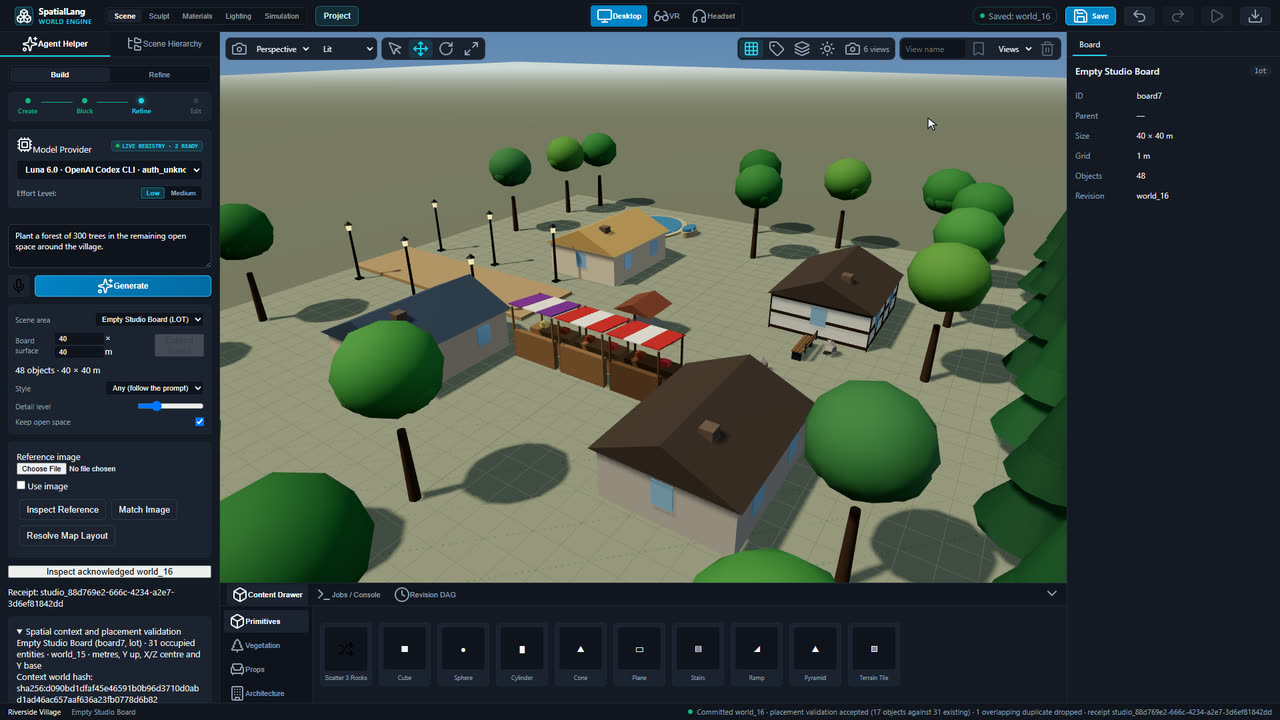
Riverside Village
6 requests · 63 s of generation
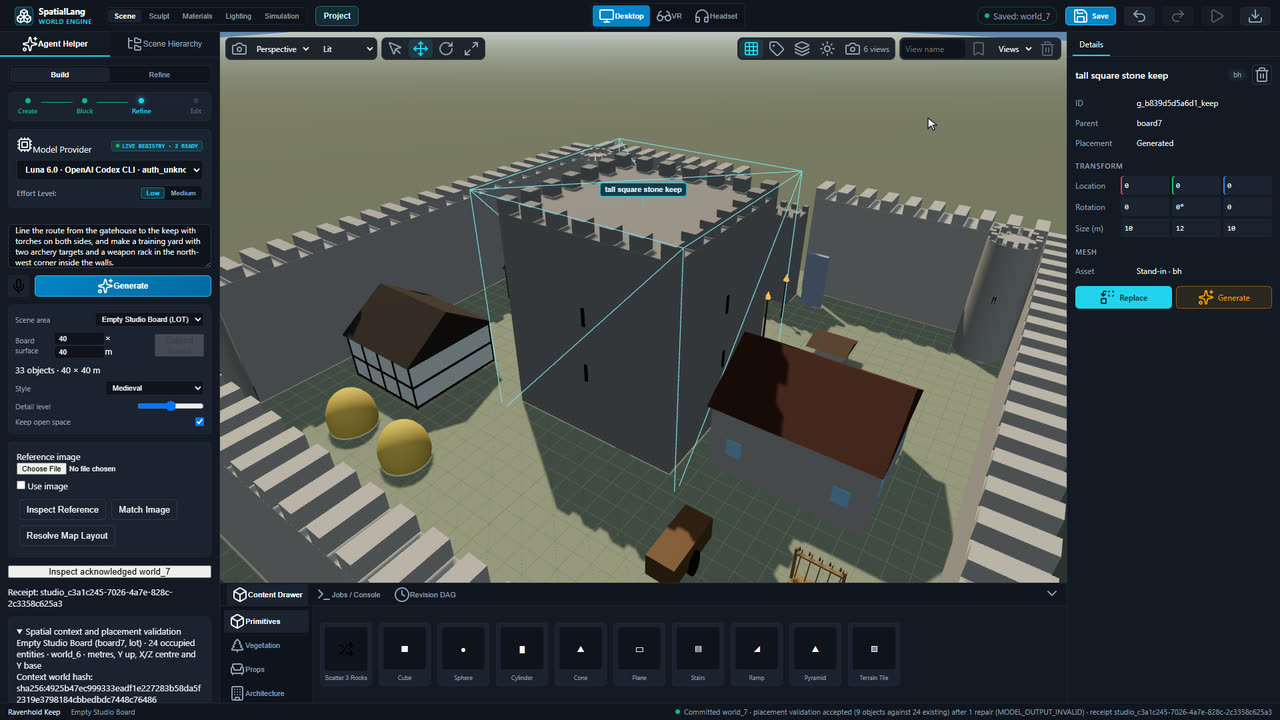
Ravenhold Keep
5 requests · 67 s · 3 self-repairs
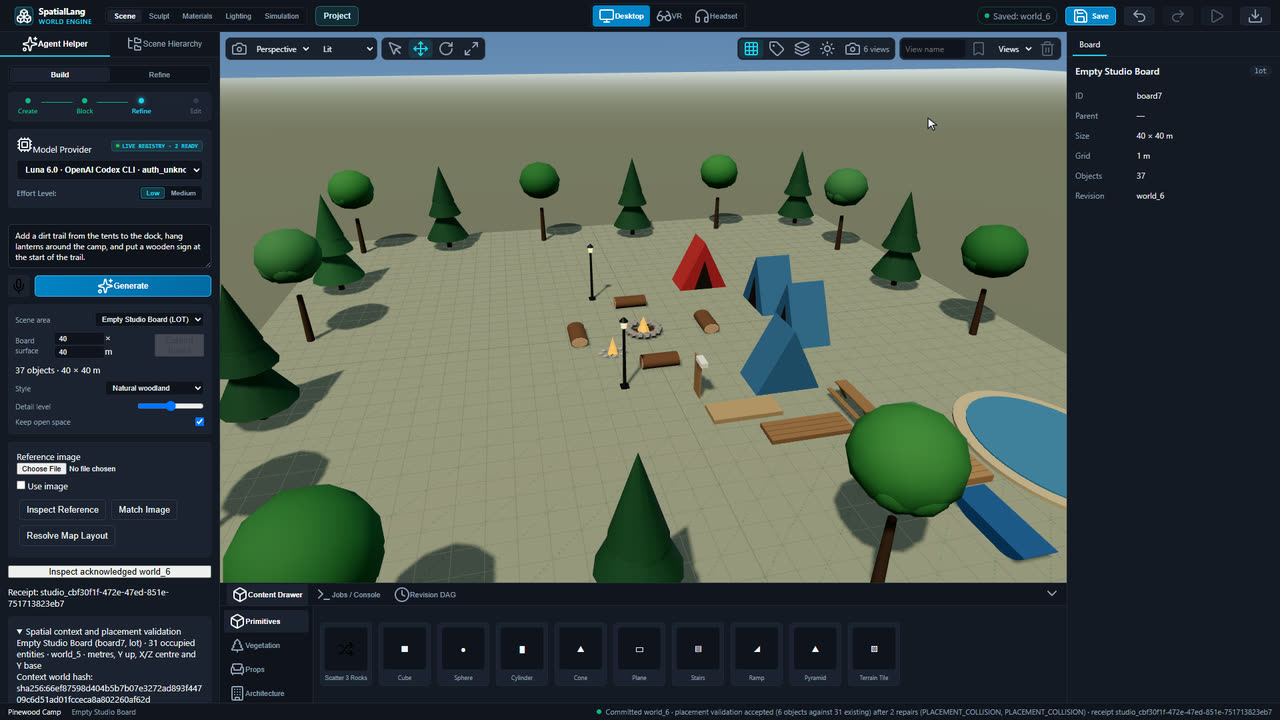
Pinewood Camp
4 requests · 78 s · 4 self-repairs
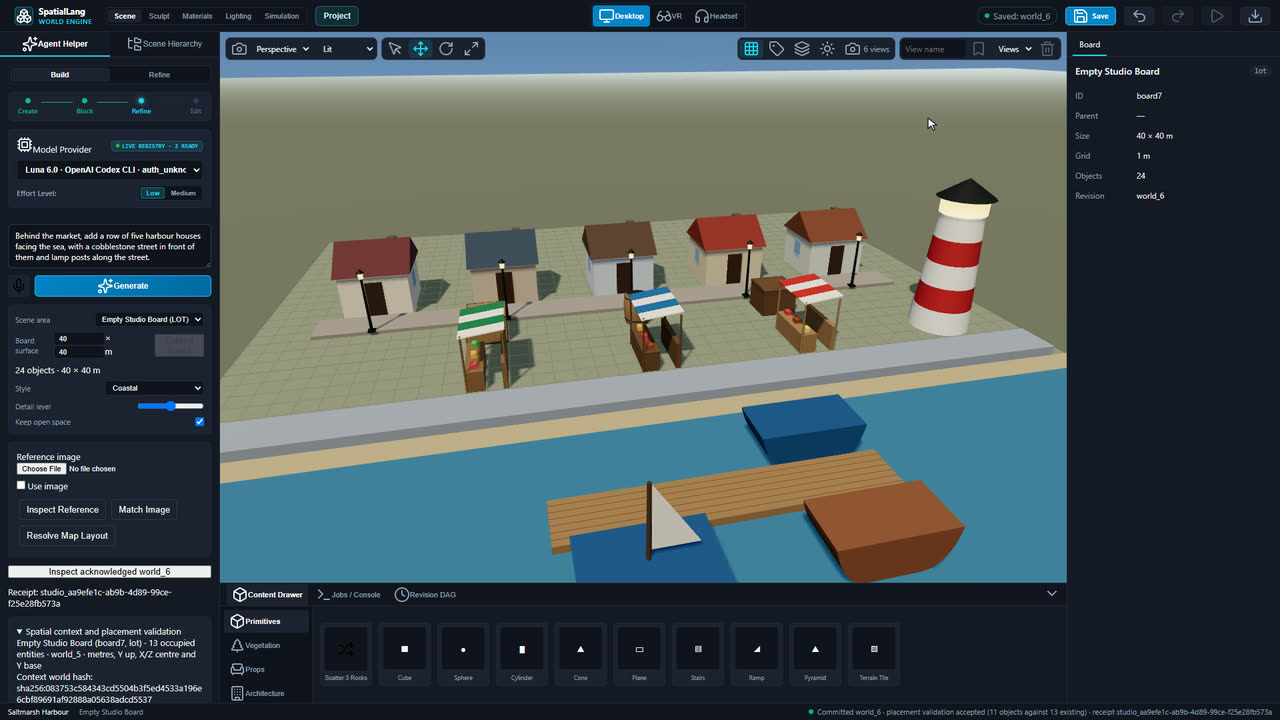
Saltmarsh Harbour
4 requests · 28 s of generation
06 · Trust it
Big asks. Full history.
"Plant a forest of 300 trees" becomes a representative forest in the free space - not a failure. And every change is a saved revision you can undo, redo or branch from, kept in a local project file.
07 · Direct it
Then put people in it.
A plain-language direction becomes a cast, timed moves and named cameras on a finished world. The scene never changes the world - it's a saved, replayable timeline.
▍
4
cast
19
moves
42 s
scene
9 s
to direct
Beat 1 of 4 · real playback08 · Shoot it
Cast in the world. Any camera.
Directed performers moving through real SpatialLang worlds, shot from named and free cameras. Every frame here is a native Studio render - stand-in figures, real timing.
One 22 s performance - the mayor, Mara and Tomas walking the village road - exported from eight named cameras at once, frame-synchronised.
09 · Finish it
Blockout in. Cinema out.
Drag across the frame. Underneath is the moving SpatialLang blockout; on top is the AI video it drove. Same shot, same layout - the world gives the model a concrete reference.
10 · Honestly
What works today. What's next.
Geometry is stand-in art sized from the generated dimensions, and performers slide rather than walk. The language, the engine and the evidence are real.
- ●Plain language → editable 3D world
- ●Validation + automatic self-repair
- ●Durable revisions, undo / redo
- ●Directed cast, moves and named cameras
- ●Certified 129× token compression
- ○Final art swap for stand-in geometry
- ○Walk cycles for performers
- ○Reusable, connected spaces
- ○Editing inside VR on the stage
Where it fits
From story to finished film.
Next room
Morpheus Wire